01 / FUTURE MODULE
Advanced camera
A larger sensor, optical zoom and stabilized video.
 Companion Robot V1
CMD HARDWARE / CONCEPT 001
A mobile AI companion designed to move through the world with you, understand its environment, and gain new capabilities over time.
See it in motion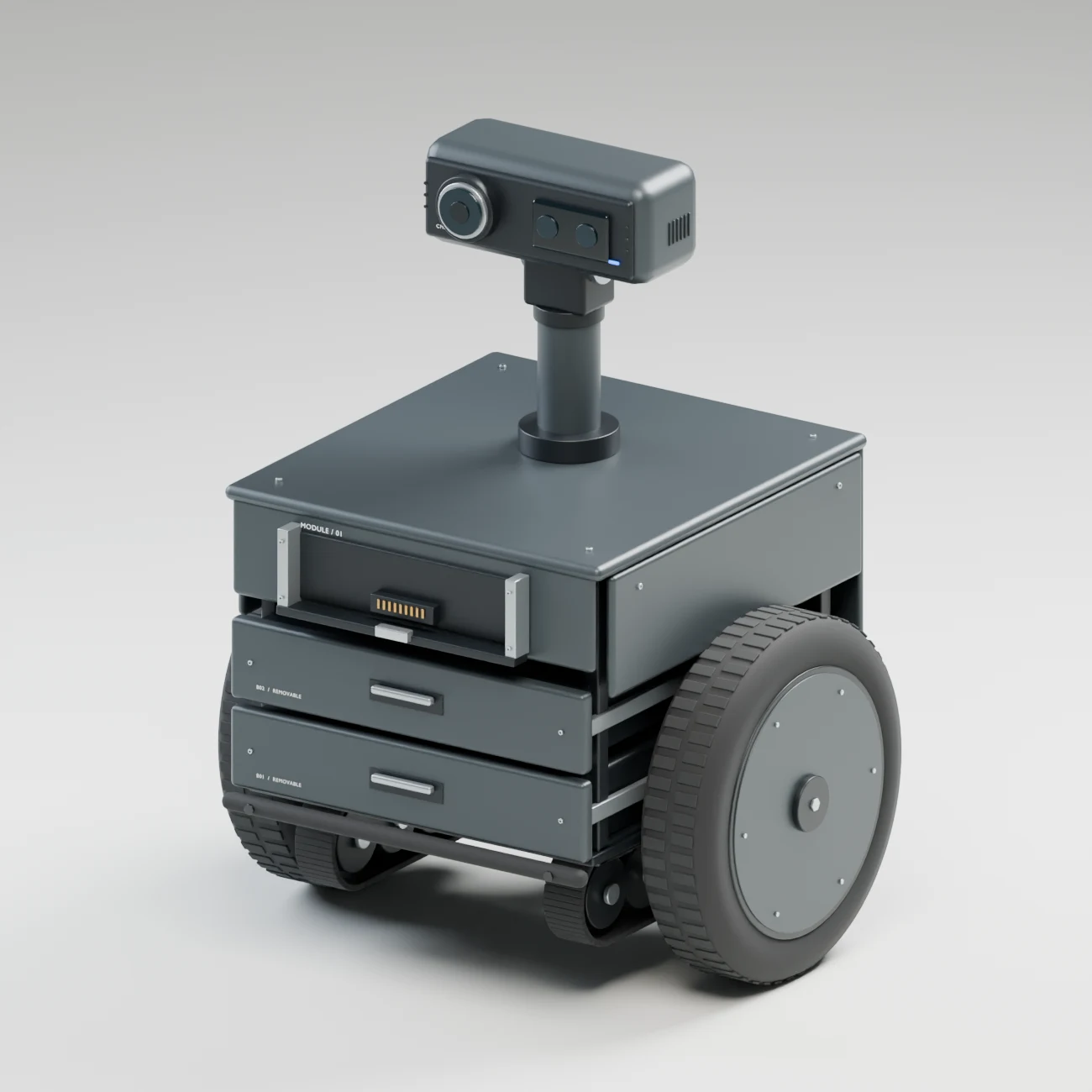
01 / A PHYSICAL PLATFORM FOR AI
Start with the essentials: move reliably, perceive the world, hold a conversation and return to charge.
Then add capabilities through a standardized powered module bay. Upgrade the camera, compute or tools while keeping the platform you already know.
02 / EVERYDAY PRESENCE
A walk along the sidewalk. A ride to the next floor. Two short concept films explore how V1 could move through familiar places.
A steady roll past storefronts and benches, with the camera moving alongside V1.
Concept animation.
Intended behavior, visualized.
THE DESIGN, IN THREE DIMENSIONS
Turn the robot around, open up the assembly, and inspect the proposed track stance. Every view comes from one Blender model, with individually modeled wheels, batteries and internal components.
BLENDER STUDIO RENDERRotate, zoom, and look inside
Solid wheel hubs, a low battery stack and a pan-and-tilt sensor head. Rotate to see the rear caster and service panels.
Modeled in Blender at real scale. A design and packaging study; mechanisms and performance remain engineering targets.
03 / TWO WAYS FORWARD
Quiet, efficient wheels for everyday movement. Retractable rubber tracks for a proposed step-by-step stair system. Elevators remain the preferred route when available.
Track deployment study · stair performance unvalidated04 / NATURAL INTELLIGENCE
Say what you need. A conversational AI interprets your intent and calls on a library of robot skills, grounded in what the robot can see and sense.
“Follow me and take a picture when we get outside.”
RGB and depth sensing, peripheral obstacle detection and a microphone array provide context.
A cloud-connected language model supports richer reasoning, preferences and context in V1.
Navigation, perception and safety controllers run onboard. Safe movement must not depend on a cloud connection.
Additional planned skills: record video, explore / map, patrol, find me and remember object locations.
05 / POWER, GROUNDED
Two removable battery cartridges sit low between the wheels, keeping mass close to the ground and the upper body available for new capabilities.
Automatic dock charging is a V1 target. Hot swapping is a future capability. Runtime varies with terrain, stairs and module use.
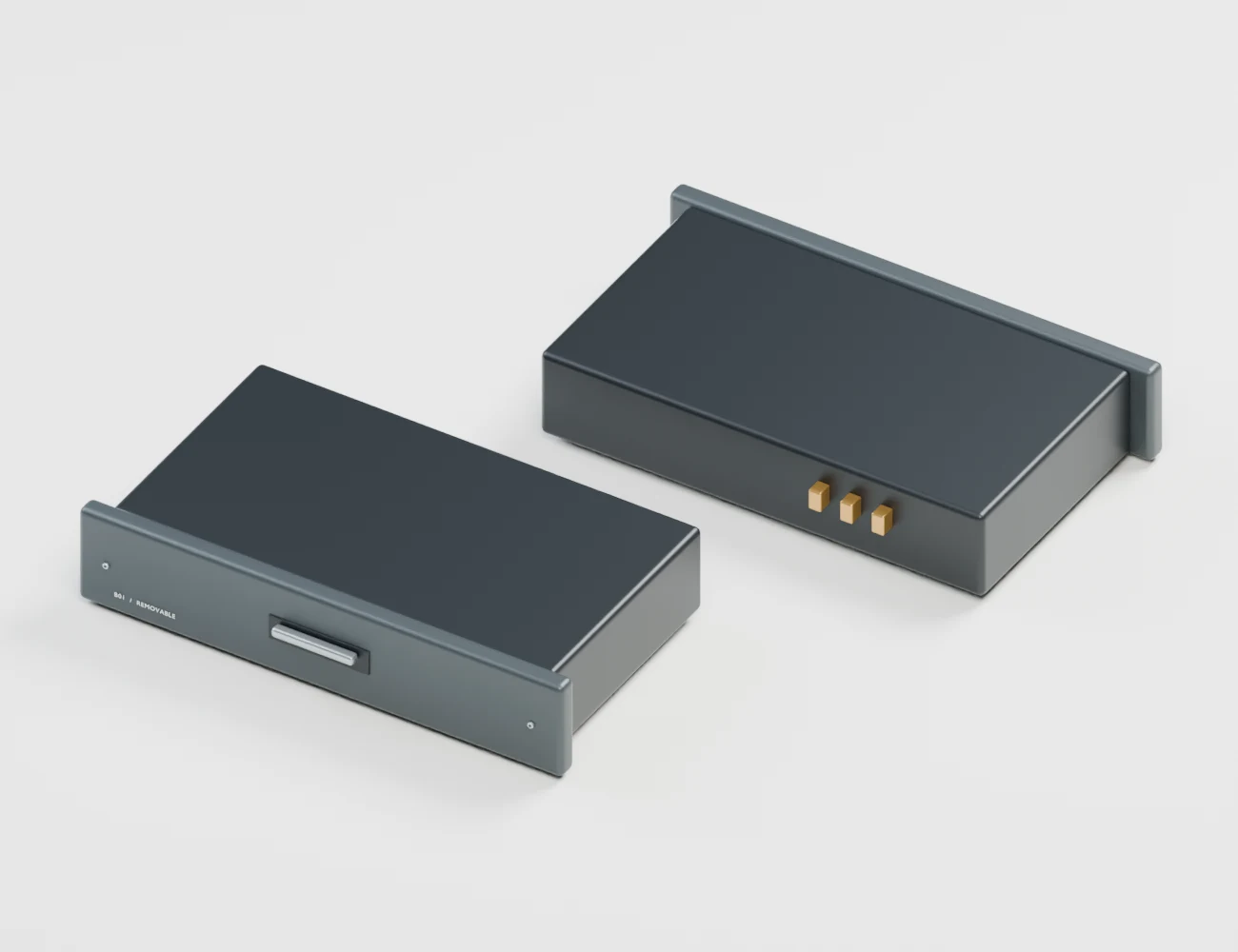
Per cartridge: ~30 × 15 × 5–7 cm · ~2–3 kg
06 / BUILT TO BECOME MORE
The chassis is the foundation. Independently replaceable modules let the hardware grow with your needs, without replacing the whole robot.
A larger sensor, optical zoom and stabilized video.
Presentations, media and contextual interfaces on a nearby wall.
An articulated arm, gripper and interchangeable tools.
Carry small essentials, tools or custom hardware.
Air quality, thermal imaging and environmental sensing.
Optional LTE / 5G, with more connectivity options over time.
V1 focuses on mobility, perception, conversation and charging. Arms, cooking assistance, drones and complex manipulation belong to the longer-term roadmap. Autonomous escalator use is outside V1 scope.
07 / ENGINEERED AS A SYSTEM
Functional over cute. A compact, low-center-of-gravity platform with removable panels and accessible components.
 Blender assembly study · concept geometry
Pan / tilt neck, RGB camera, depth camera or compact LiDAR, microphone array, speakers and subtle status lighting.
Embedded CPU / GPU, AI accelerator and a separate local navigation and safety controller.
Powered module interface, serviceable frame, removable panels and room for future upgrades.
Two low-mounted cartridges, temperature monitoring and charging contacts for the automatic dock.
Wheel motors, suspension, stabilization wheel and retractable tracks. IMU, encoders, proximity, bumpers, motor-current and tilt / fall sensing.
08 / THE V1 ENVELOPE
Preliminary design targets, subject to engineering validation. Illustrations are concept studies, not final hardware.
CMD / COMMAND LAYER SYSTEMS
A really good mobile body for AI.
Everything else is a capability you add.